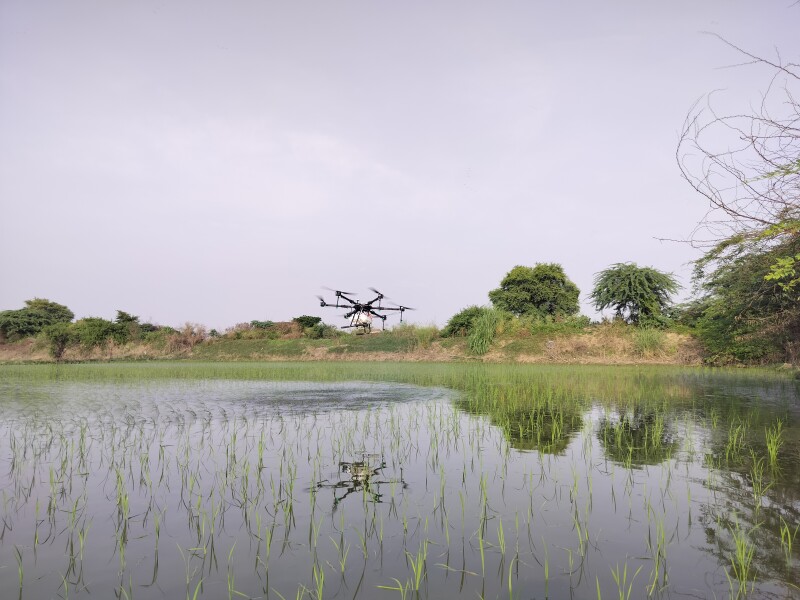
As agricultural UAV adoption accelerates, decision-makers often rely on anecdotal evidence or vendor specifications to justify deployment. However, data-driven evaluation of UAV spraying systems remains surprisingly scarce in industry discourse, particularly when it comes to environmental performance, resource efficiency, and operational trade-offs.
Over multiple field trials and simulation-based studies conducted across Northern and semi-arid regions of India, I evaluated UAV spraying systems using quantitative life cycle assessment (LCA), machine learning–based performance modeling, and comparative nozzle-level experimentation. The results offer concrete insights into where UAVs deliver measurable advantages, and where assumptions break down.
Across crops including rice, mango orchards, and sugarcane, UAV-based spraying consistently demonstrated an order-of-magnitude reduction in water consumption compared to conventional ground-based spraying.
However, data also showed that incorrect nozzle selection or excessive flight overlap negated up to 30-40 percent of expected water savings, reinforcing the need for parameter optimization rather than blanket adoption.
While UAV spraying eliminated fuel combustion at the field level, battery charging energy and operational intensity became dominant contributors to the carbon footprint. Under optimized operations, UAV systems demonstrated lower or comparable CO?-equivalent emissions per hectare relative to tractor-based spraying.
The models successfully identified non-linear relationships between spraying parameters and efficiency metrics, enabling predictive optimization rather than reactive correction. This approach allows operators to pre-select mission configurations that minimize environmental cost while maintaining agronomic efficacy.
Published on 2/13/2026