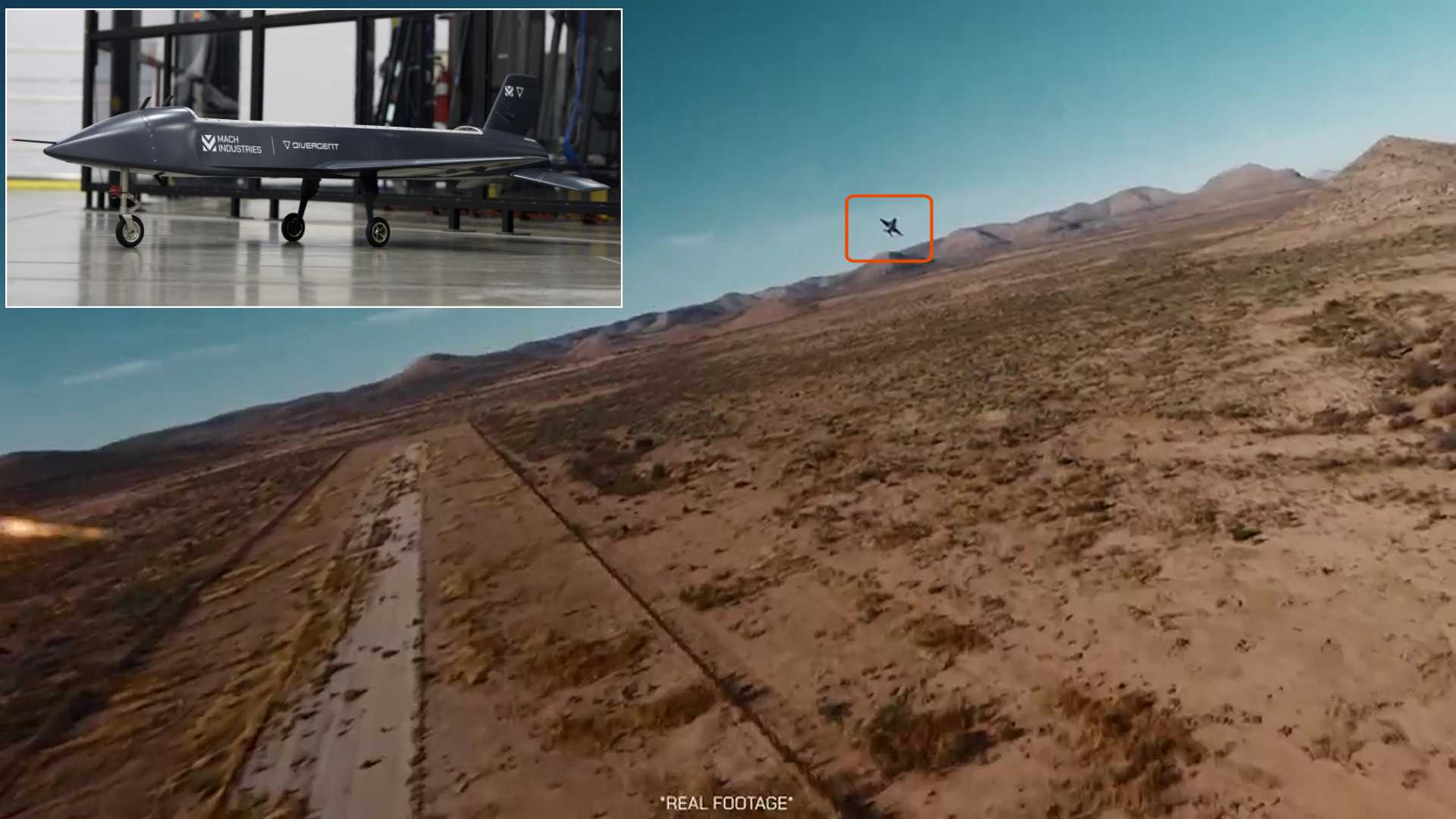
US companies Mach Industries and Divergent Technologies completed the first flight of the Venom autonomous strike aircraft on February 17, 2026, only 71 days after the drone's conception.
On February 17, 2026, the U.S. companies Divergent Technologies and Mach Industries announced that they completed the first flight of the newly-developed Venom autonomous strike aircraft. The prototype moved from concept to flight-ready configuration in 71 days through a digitally integrated design and 3D printed manufacturing process. The program, aligned with the Pentagon’s affordable mass and rapid acquisition strategy, is positioned as a test case for rapid defense production and affordable mass unmanned systems.Follow Army Recognition on Google News at this link
Concerning workshare distribution on the Venom autonomous strike aircraft program, Mach Industries led system architecture and subsystems integration, while Divergent Technologies handled digital airframe design and 3D-printed airframe production. (Picture source: Divergent Technologies and Mach Industries)
The first flight of the Venom prototype marked the unveiling of a new autonomous strike aircraft developed from initial design to flight-ready configuration in 71 days. The Venom drone was built as a flight demonstration vehicle to illustrate how a compressed hardware development cycle enabled by digital engineering and additive manufacturing could work. The companies stated that the program moved from concept to first flight in just over two months, and they positioned the timeline as evidence of a shift toward software-driven defense manufacturing. Photographs released with the announcement showed U.S. Secretary of Defense Pete Hegseth alongside company executives, indicating visibility at senior levels within the Department of Defense.
However, the two companies did not disclose range, payload, endurance, propulsion specifications, autonomy architecture, or projected unit cost, leaving operational parameters undefined at this stage.“Mach Industries, founded in 2023 and headquartered in Huntington Beach, California, led the establishment of baseline requirements and system architecture for the Venom. The company stated that it leveraged avionics and simulation derived from existing flight-proven technology stacks and implemented a modular open-systems architecture to accelerate development from concept to flight. A common simulation and controls foundation was used to support high-fidelity prototyping and iterative refinement across hardware and software.
Mach indicated that this framework enabled parallel development and accelerated validation during the 71-day cycle. The company also stated that it vertically integrates propulsion, weapons, and manufacturing processes to reduce development timelines and increase control over production scalability. Divergent Technologies, founded in 2014 and based in Torrance, California, executed the digital design and additive manufacturing of the Venom structure using its Divergent Adaptive Production System. Instead of assembling the airframe from hundreds of individual components, the company 3D-printed large monolithic aluminum assemblies, including wings, fuselage sections, skins, and control surfaces.
Published on 2/21/2026