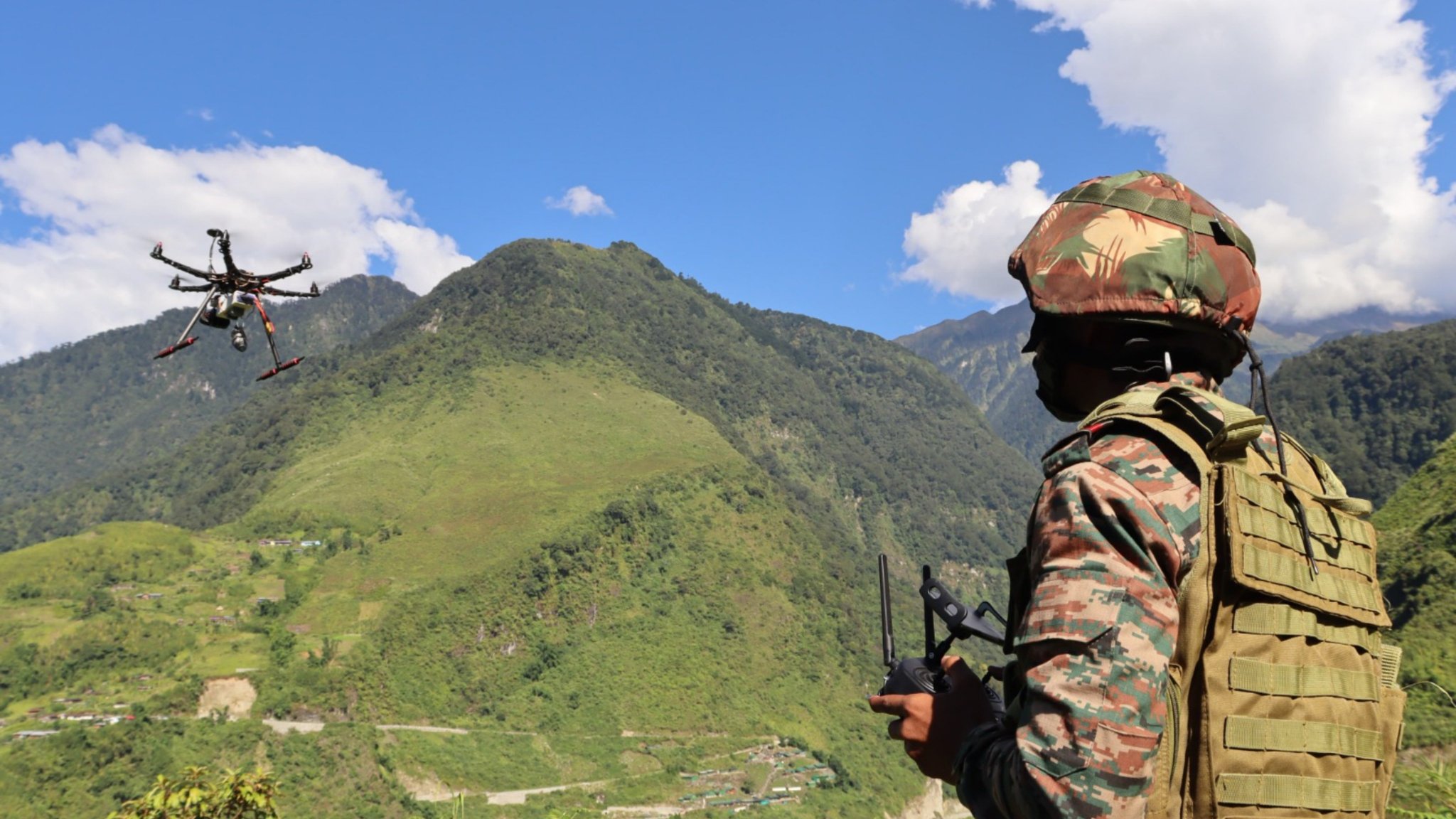
The Indian Army is seeking to strengthen its counter-unmanned aerial systems (C-UAS), and simultaneously it is pursuing additional armed unmanned aerial vehicles (UAV) possessing a surveillance capability.
On 20 February, India’s Ministry of Defence issued a request for information (RfI) for up to 45 drone interception systems plus up to 50 drone catcher systems for the army. They will be deployed across varied Indian terrain — such as plains, deserts and high-altitude areas — in support of field formations and to protect vital installations.
The army is faced with a growing aerial threat from drones with a low radar cross-section (RCS) and employed individually or in swarms. This was experienced last year during operations against Pakistan as part of Operation Sindoor.
The requested drone interception system is required to detect and counter hostile low-RCS drones and UAVs through kinetic means. The system must also be capable of operating independently or in conjunction with existing army air defence systems and other C-UAS assets.
Key performance parameters listed by the army are simultaneous detection and tracking of at least 20 drones. Nor should its deployment time exceed ten minutes. The minimum slant range listed for the drone sensor should not be less than 4km for a 0.001m” RCS, and a minimum of 10km for 0.05m” RCS targets.
As for the drone catcher system, it should incorporate four net catcher modules per system. A jammer subsystem will also provide C-UAS electronic attack capabilities, including radio frequency denial, and selective global navigation satellite system denial and deception.
Published on 3/4/2026