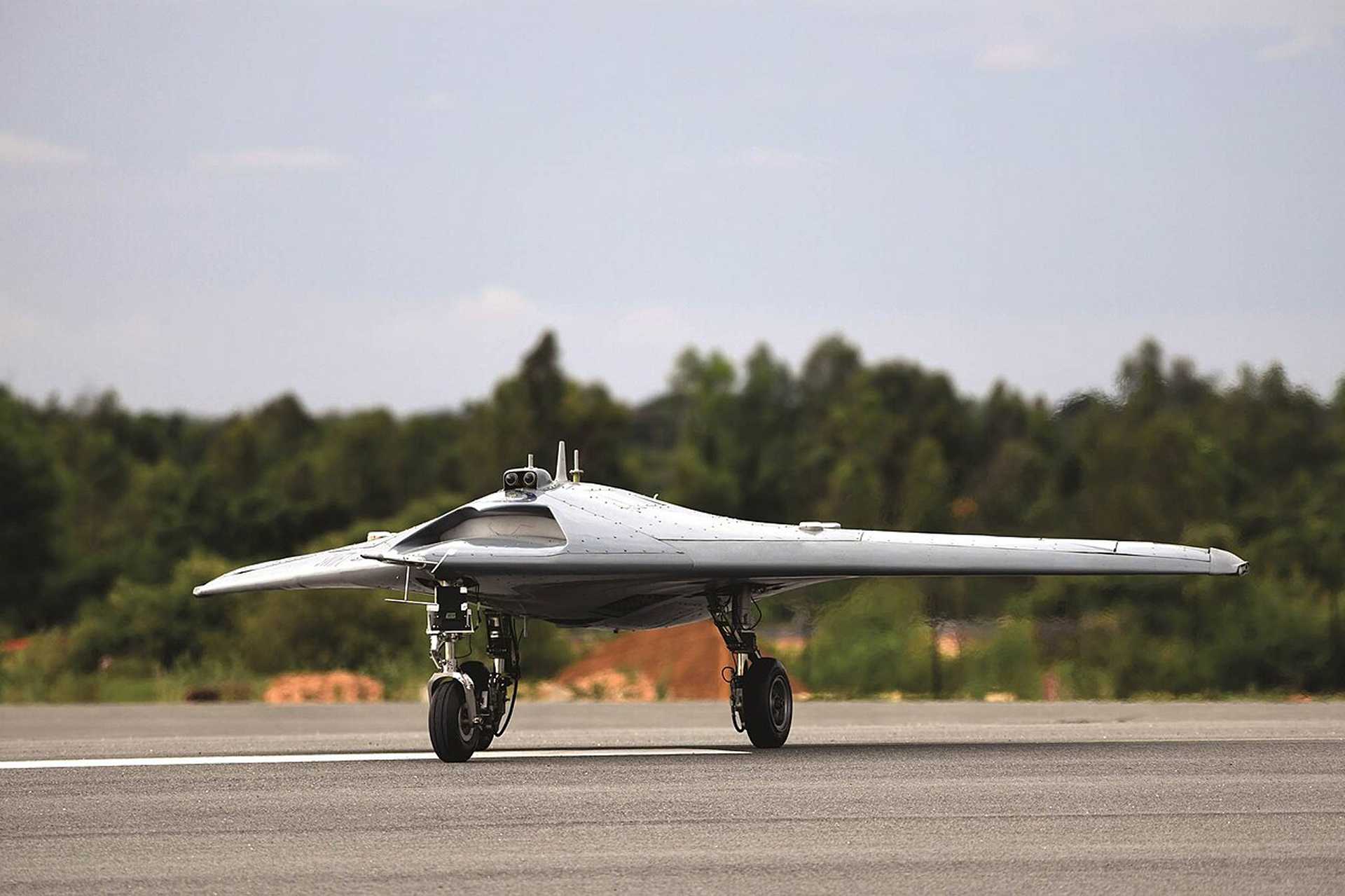
India’s Defence Procurement Board recommended the acquisition of 60 Ghatak unmanned combat aerial vehicles on March 3, 2026. The proposal now moves to the Defence Acquisition Council, chaired by Defence Minister Rajnath Singh. The stealth flying wing drone is being developed by DRDO as part of long-term force development under the Vision 2047 roadmap, for deep strike missions, air defence suppression, and coordinated operations with fighter jets such as the Tejas.Follow Army Recognition on Google News at this link
The Ghatak relies on a low radar cross section, internal weapon carriage, and an autonomous operating logic that would allow it to undertake deep-strike missions without exposing pilots to direct risk. (Picture source: Indian MoD)
As reported by Business Standard on March 3, 2026, India's Defence Procurement Board recommended the acquisition by the Ministry of Defence of 60 units of the Ghatak unmanned combat aerial vehicle (UCAV). The recommendation now moves to the Defence Acquisition Council, chaired by Defence Minister Rajnath Singh, for approval before procurement decisions are finalised. Developed by the Defence Research and Development Organisation (DRDO) for the Indian armed forces, the Ghatak is intended primarily for the Indian Air Force as part of long-term force planning under the Vision 2047 capability roadmap.
This roadmap integrates unmanned combat aircraft into the future combat structure alongside manned fighters to field an indigenous stealth strike drone capable of operating in high-threat environments. The acquisition of 60 units corresponds to a first operational batch of unmanned combat aircraft designed for deep-strike missions and suppression of enemy air defences.“The Ghatak drone is a jet-powered unmanned combat aerial vehicle (UCAV) built around a flying-wing configuration to reduce radar detection and improve aerodynamic efficiency. The design also eliminates conventional tail surfaces, which lowers radar reflections and allows the drone to penetrate defended airspace protected by radar networks and missile systems.
The Ghatak incorporates an internal weapons bay for missiles, bombs, and precision-guided munitions, preserving its low observable characteristics during combat operations. Intended mission sets include deep strike, suppression and destruction of enemy air defences, and attacks on strategic infrastructure such as command centres or radar installations. As the Ghatak can operate autonomously or alongside manned combat aircraft during coordinated missions, the drone may enter contested zones ahead of Indian fighter jets, such as the Tejas and the AMCA, to identify threats and strike priority targets.“The Ghatak originates from the earlier Autonomous Unmanned Research Aircraft (AURA) program initiated in 2009 to examine the feasibility of an Indian stealth unmanned combat aircraft.
That program concluded in April 2013, but was followed by the Ghatak UCAV development effort led by the Aeronautical Development Establishment with design work involving the Aeronautical Development Agency and cooperation with the Indian Air Force. The Ghatak UCAV is expected to weigh less than 15 tonnes and operate at altitudes up to 30,000 feet while carrying internal payloads of guided weapons. Onboard systems include mission computers, fire control radars, identification friend-or-foe equipment, collision avoidance systems, and secure data links. Autonomous navigation, mission management, and sensor fusion are central elements of the drone’s architecture. These systems enable the Ghatak drone to detect, track, and engage targets without direct pilot control while remaining connected to command networks.
Published on 3/12/2026