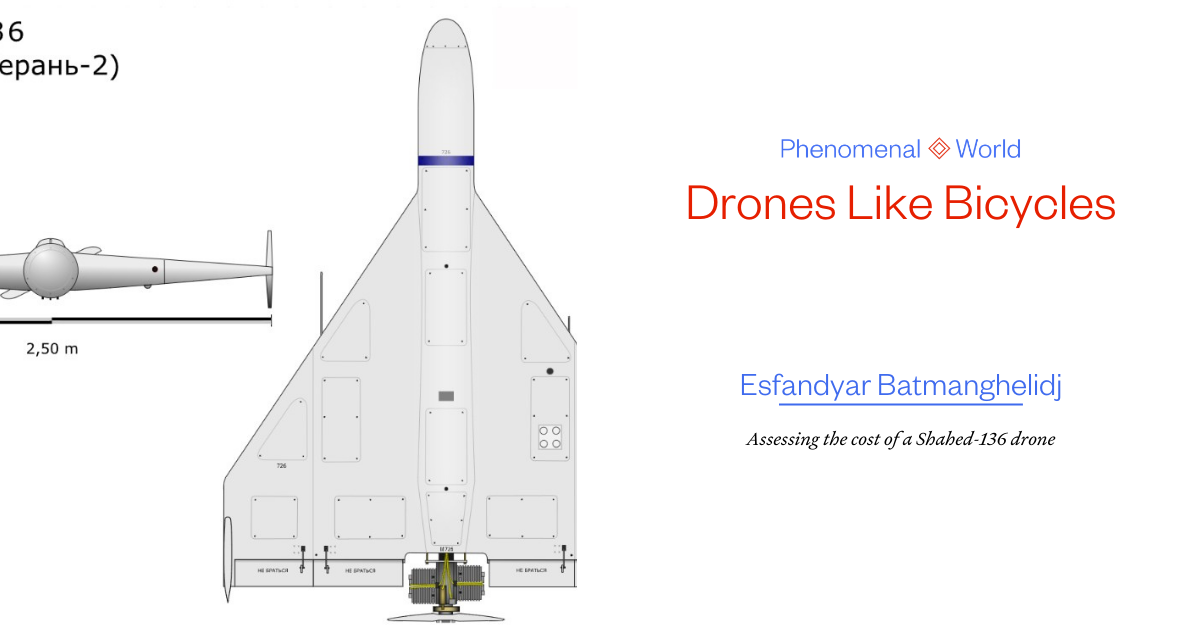
An Iranian-made Shahed-136 drone is a simple weapon. The delta wings, which span 2.5 meters, are made of fiberglass and end in two fixed vertical stabilizers. The rear control fins are operated by simple servos. The drone carries an autopilot system, a global positioning receiver, and a data module. Propulsion is provided by a basic air-cooled four piston motor, made of cast aluminum, producing 50 horsepower to drive a pusher propeller. While built to aviation specifications, the motor is not unlike that found on a small motorcycle. The drone can fly at a speed of 185 kilometers per hour while carrying a 40-kilogram warhead over a distance of 2,000 kilometers.
This simple weapon has thrown the global economy into disarray. Since the US and Israel started an illegal war against Iran on February 28, Iranian forces have responded by launching thousands of Shahed-136 drones at targets across the region. These have struck not just military sites, but also civilian infrastructure, including refineries, power plants, airports, hotels, and ships; the drones have comprised a central element of Iran’s retaliatory strategy, and brought maritime and air traffic to a halt. Gulf Kingdoms, Israel, and the US have expended scarce and expensive interceptor missiles to repel drone attacks. Most interceptions have been successful, but the sheer volume of launches means Iran has hit many of its targets.
To make sense of the long-range air weaponry that defines the widening devastation and the havoc produced by Iranian drones, reporters have fixated on the cost of the Shahed-136 platform. Dozens of articles cite the cost of the drones as somewhere in the $20,000 to $50,000 range’a mere fraction of the cost of interceptor missiles, whose price tag can reach up to $3 million. The price juxtaposition is getting a lot of attention, as an evocative illustration of fast-evolving contemporary warfare.
But is the comparison accurate” An analysis by the think tank CSIS on the price of the Russia’s Shahed-136 variant explains the unscientific way these estimates are usually devised:
It is difficult to precisely know the per-unit cost of Russia’s Shahed-type drones, which Russia manufactures domestically as the “Geran-2.” One Israeli missile expert, writing in January 2023, estimated as little as $20,000?$30,000 per drone. Later, a British analyst put the figure closer to $80,000, based on his personal inspection, in October 2022, of the components of a captured Shahed-136. Forbes Ukraine has used $50,000 per Shahed to calculate the cost of Russian attacks” Nevertheless, for our calculations, we used a conservatively high unit cost of $35,000’the midpoint between the lowest cost estimate and the more often cited $50,000.
Most of the estimates of the cost of the Shahed-136 are based on analysis of the Russian variants and none of the public estimates appear to be derived from an actual breakdown of the components of an Iranian-made drone. The real costs of Iranian drones could be dramatically cheaper than assumed’the cost asymmetry more extreme. The US and Israel have installed an ever escalating sanctions regime and a still-escalating military assault with the ostensible aim of making the conduct of war too ?expensive” for Iran. As the war of choice engulfs the region and sows chaos in the global economy, it is imperative to understand how ?cheap” a war can now be.
Published on 3/14/2026