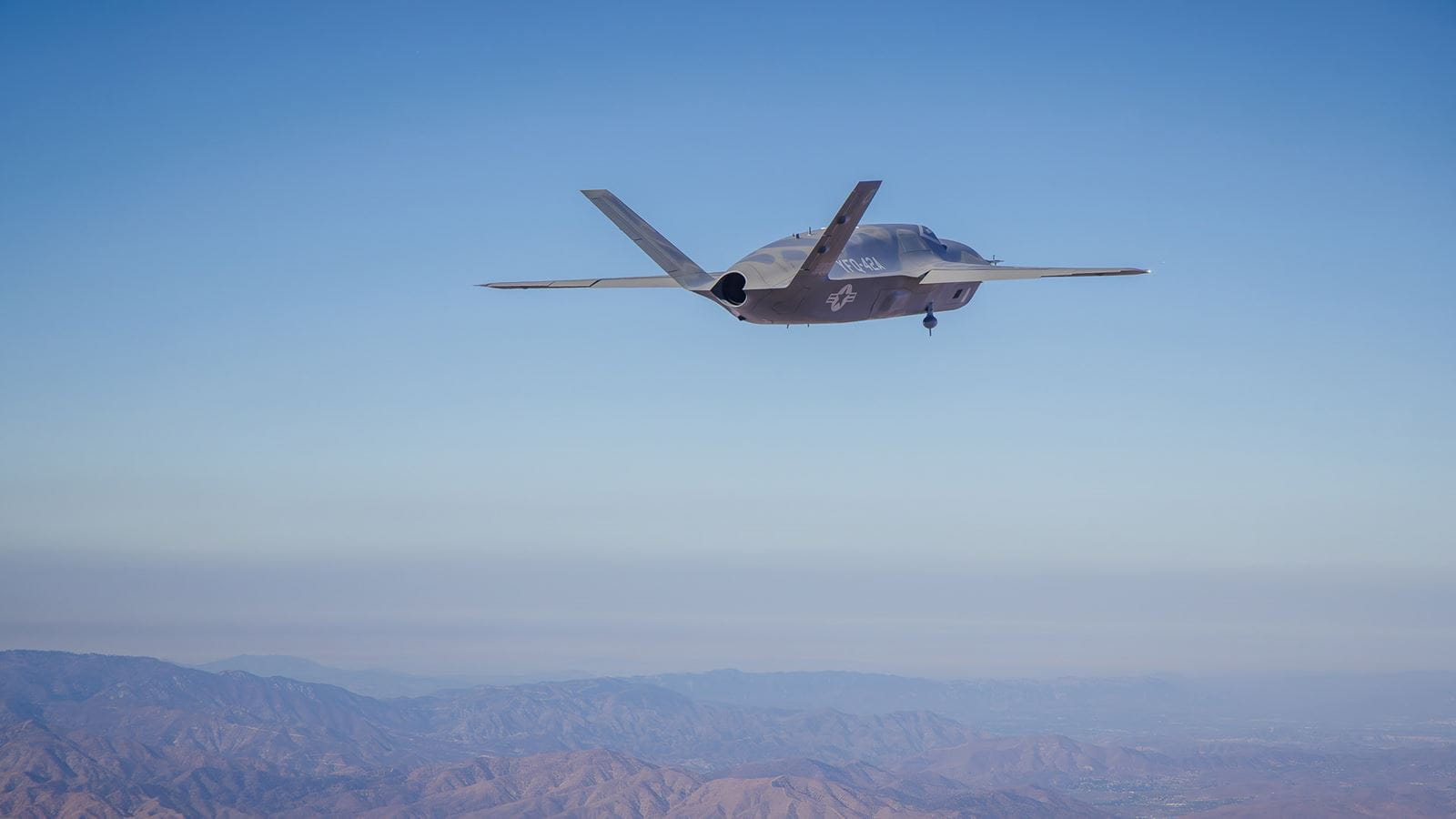
The U.S. Air Force’s Collaborative Combat Aircraft (CCA) program’which aims to procure about 1,000 autonomous aircraft to serve as ?loyal wingmen” to crewed fighter jets’is reaching new heights in 2026.
The two aircraft selected by the branch for testing and evaluation under the first CCA phase or ?increment”“General Atomics” (GA-ASI) YFQ-42A Dark Merlin and Anduril’s YFQ-44A Fury’both achieved new milestones this year after first taking flight in late 2025.
Earlier in February, the Air Force and GA-ASI’which builds uncrewed Predator attack drones such as the MQ-9A Reaper’announced that the Dark Merlin made its first semiautonomous flight alongside crewed fighters. And this week, the branch told reporters at the Air & Space Forces Association’s annual Warfare Symposium in Colorado that it has begun weapons integration testing with Anduril’s Fury, strapping inert air-to-air munitions to the drone to validate safety and airworthiness.
Carrying live munitions into combat is just one envisioned use of the CCA wingmen, which are also designed to extend the range of fighter jet sensors for enhanced situational awareness.
The Air Force expects to procure two CCA systems apiece for each of about 500 fighters obtained via its Next Generation Air Dominance (NGAD) program. It plans to order about 100 drone sidekicks during the first CCA increment.
Colonel Timothy Helfrich, who directs the Air Force’s Agile Development Office, said in September that first increment production contracts are expected to be handed out this year. They could go to one or both companies.
Published on 2/28/2026