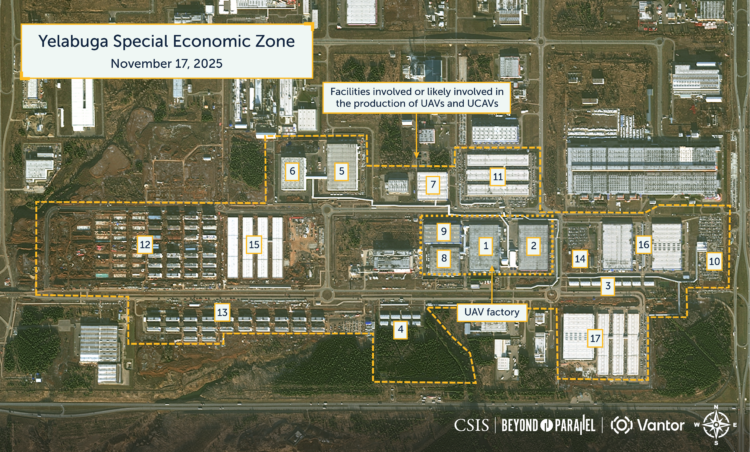
Beginning shortly after its February 2022 invasion of Ukraine, Russia faced an unprecedented and growing need for uncrewed aerial vehicles (UAVs, commonly called drones) and uncrewed combat aerial vehicles (UCAVs, commonly called attack or suicide drones), a need that rapidly outstripped its ability to produce such weapons domestically.
To address this shortfall, Russia reached out to Iran. Following several 2022 visits by Russian officials to Iran, during which they inspected the Shahed line of UAVs, the two nations concluded an agreement for the immediate supply of the Shahed-131 UAV (known in Russia as the Geran 1) and the Shahed-136 UCAV (known in Russia as the Geran 2). The first of these reportedly arrived by August 2022.2 The initial deliveries were dominated by the delta-winged Shahed-136, which Russian forces used with great effect against Ukraine, reportedly with a range of 2,000+ kilometers and a warhead of up to 90 kilograms.3
In June 2023, then National Security Council spokesman John Kirby described Russia’s expanding relationship with Iran as becoming ?a full-scale defense partnership,” with ?support flowing both ways.” Russia provided ?an unprecedented level of military and technical support” to Tehran in exchange for Iranian UAVs, UAV production technology, and other equipment for use in Ukraine.4 Among this support was the establishment of a UAV factory within the Yelabuga Special Economic Zone (SEZ) to produce the Shahed-131 and Shahed-136.5 The agreement between the two countries called for Iran to assist in establishing a Russia-based manufacturing plant for the Shahed-131, Shahed-136, and other systems.6 This assistance included advisors, training, production equipment, and an initial supply of components.
In addition to Iranian technical support, Russia appears to be broadening its external partnerships. In late 2024, Ukraine claimed that North Korea was supplying Russia with personnel for Russian factories, with subsequent media reports in November 2025 indicating that North Korea is supplying 12,000 workers for the SEZ.7 The specific nature and extent of any North Korean involvement in the production or design of UAVs at the Yelabuga SEZ remain unknown, aimed that North Korea was supplying personnel to Russia.8 However, given the unprecedented level of Russian-North Korean military and technical support, there is a better-than-even chance that, at a minimum, North Korean UAV designers and engineers have visited the facility to study the design and production processes for the UAVs and UCAVs produced there. Any North Korean involvement with the Yelabuga UAV factory will likely bring Russian wartime UAV experience and technology back to North Korea, which will be of considerable value to the country’s expanding UAV and UCAV programs.9
The SEZ’s importance to Russian ambitions is evident in satellite imagery analysis of the Yelabuga SEZ from late 2021, prior to the Russian invasion of Ukraine, through the present, showing a sustained and deliberate expansion of infrastructure and supporting facilities consistent with the rapid scaling up of UAV and UCAV production.
The location chosen for the Iranian-supported UAV factory was the Yelabuga special economic zone (SEZ), approximately 1,100 kilometers east of the Ukraine border, eight kilometers north of the city of Yelabuga, and bounded by the small Tatarstan villages of Bekhterevo to the east and Bolshaya Kachka to the west. Archival satellite imagery shows that the Yelabuga SEZ began development in 1986. Since then, the Yelabuga SEZ, like many other Russian SEZs, has gradually expanded as part of efforts to support the development of a more diversified and robust Russian economic infrastructure. This gradual expansion continued through 2022, when it accelerated dramatically.
Published on 3/12/2026